
What the Video Shows
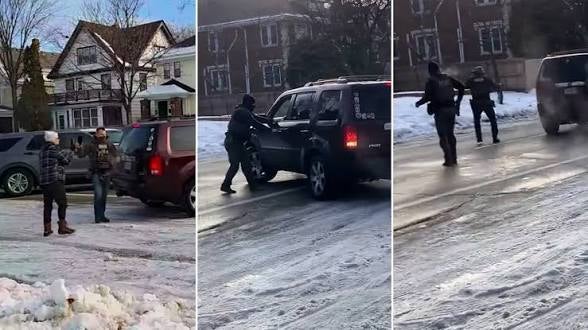
The video begins with multiple federal agents surrounding Good's SUV and shouting commands for her to exit. There is visible confusion and inconsistent instructions being yelled at the same time. As the vehicle begins to turn and move forward, an ICE agent positioned near the front draws his handgun and fires a shot towards the windshield while sidestepping, and firing two additional rounds through the driver's side window at close range. The SUV continues forward and crashes into another car.
Good was transported to Hennepin County Medical Center, where she later died of her injuries. According to local reporting, she was not being arrested on a warrant and was not the original target of the enforcement operation.
The footage has since been replayed across major outlets and social media platforms, creating the rare situation where the public sees the critical moments before any official investigation is completed.
The Federal vs. Local Narratives
The release of the video created two sharply different interpretations.
Federal officials have described the incident as a case of self-defense, claiming Good used her vehicle as a weapon and attempted to ram the agent. Under this view, the shooting falls into the category of split-second deadly force, where officers make rapid decisions during perceived life-threatening situations.
Local officials, including Minneapolis Mayor Jacob Frey, publicly rejected that version after watching the footage. Frey stated that the video did not show the agent in the vehicle's path and that Good appeared to be driving away, not toward the officer. Minnesota Governor Tim Walz has also questioned the self-defense justification and called for transparency.
These competing narratives explain why the video has taken on such importance: the facts and the perception of threat look very different depending on which narrative is adopted.
Why the Video Matters for Legal Analysis
Video evidence now plays a central role in evaluating police shootings, especially those involving vehicles. In cases involving deadly force, courts focus on specific details captured on video, including:
- the direction of movement,
- the speed of the vehicle,
- the distance between the officer and the vehicle,
- whether the officer had the ability to move out of the way,
- the timing of the shots, and
- whether any perceived threat was ongoing or had already passed.
These details help determine whether the vehicle was being used as a weapon or whether it was simply attempting to leave. That distinction often shapes whether deadly force is viewed as necessary or excessive under constitutional standards.
Shooting at Moving Vehicles Is Highly Controversial
The video has also drawn attention because many law-enforcement agencies discourage shooting at moving vehicles except in narrow circumstances. The rationale is practical: bullets rarely stop a moving vehicle, and shooting the driver can cause a loss of control that endangers nearby officers, pedestrians, and other motorists. In many scenarios, officers can simply move out of the vehicle's path without resorting to deadly force.
Policies like these exist precisely because shootings involving vehicles have historically produced poor outcomes for public safety. Much of the current debate about the Minneapolis shooting centers on whether the agent faced an unavoidable threat or whether disengagement was a safer alternative.
Public Opinion Is Moving Faster Than the Investigation
The official investigation has only begun, but public judgment has already accelerated because the video is widely available. This dynamic has become common in modern police shootings: once video enters the public domain, it begins shaping narratives before law enforcement agencies and prosecutors issue findings.
For Minneapolis—a city still deeply affected by the killing of George Floyd—the presence of immediate video footage carries added weight. Residents are no longer willing to wait months for lengthy investigative reports when the core moments are visible on camera.
What Happens Next
Several processes are now underway at the same time. The FBI is leading the federal review of the shooting. Minnesota officials have signaled that state authorities also want access to the case. Civil litigation is possible, particularly from Good's family, because video evidence makes legal claims more viable. At the same time, debate has already begun about the tactics federal agents are using in immigration enforcement operations in U.S. cities.
These developments will unfold over time, but the video ensures that none of them will happen quietly.
Why This Incident Matters Beyond Minneapolis
The shooting did not occur during a high-risk warrant involving a violent suspect. It unfolded on a city street during a broad immigration operation, involving a person who was not accused of a violent crime, and who was driving away at the moment deadly force was used.
That combination of factors raises broader questions about how federal task forces operate in local neighborhoods and how deadly force should be evaluated when vehicles are involved. The Minneapolis shooting illustrates how easily a routine encounter can turn into a fatal incident once firearms are introduced.
Bottom Line
The video is driving national attention because it compresses several complex questions into a few visible seconds: Was there a threat? Was deadly force necessary? Was the officer actually in danger? And does the video contradict the official explanation?
Those questions will not be fully answered until the investigations conclude, but one fact is already clear: in the age of bystander video, the public sees the evidence long before the legal system delivers a verdict.

Comments
There are no comments for this post. Be the first and Add your Comment below.
Leave a Comment